Conclusion
The widening of the river becomes more pronounced near Sainte-Félicité, and the mountainous landscape blends into the river, creating this panorama. Geographically, Sainte-Félicité can be seen as the gateway to Gaspésie
Were it not for the COVID-19 pandemic, celebrations could have been held to honor the efforts of our builders. But Sainte-Félicité knows how to adapt to change.
May this historical journey inspire the people of this municipality to continue fostering its growth and development, and to take pride in living there.
Economic activities
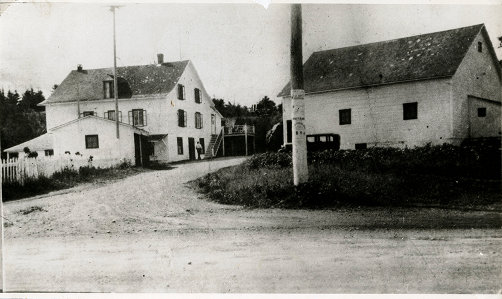
The Frédéric Ouellet flour mill, built around 1845, later had a sawmill added several years afterward. This mill was sold to Camille Rivard around 1883.
Because of the short seasons, activities related to agriculture, logging, and fishing alternate throughout the year. Land routes are poorly developed, and it is the residents of the new settlement who build the roads. Since the marketing of timber and agricultural products requires a good communication network, water transportation plays a very important role in economic exchanges. This led to the construction of the wharf and its extension in 1937, which increased its capacity to accommodate schooners.
Because of the vast territory available for settlement, the clearing of new lands was encouraged. The Catholic Church supported this development by appointing missionary colonizers. The first true missionary of Sainte-Félicité was Abbé Esdras Rousseau. Difficult before 1870, agricultural production gradually developed around wheat, potatoes, and oats. The soil was fertile, but climatic constraints related to the short summer season limited production. The dairy sector expanded, and a new opportunity arose: butter production.
hus, household income is multidimensional, with agriculture, livestock farming, timber exploitation, and dairy production all coexisting.
Quelle Pointe
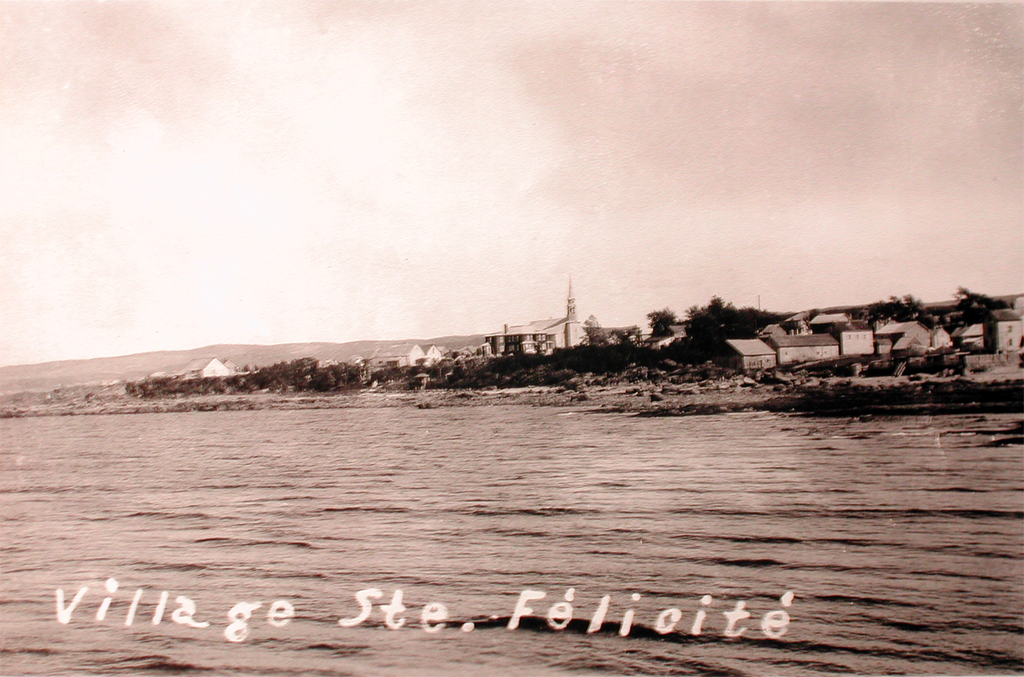
Pointe au Massacre, village of Sainte-Félicité
In 1856, a mission was established. A dispute then arose to determine the location of the chapel: La Longue Pointe or Pointe au Massacre? With the expansion of the territory to the east, Mgr. Baillargeon chose Pointe au Massacre, which was more central. The church was built in 1881, with restorations carried out over the years.
Quelle pointe
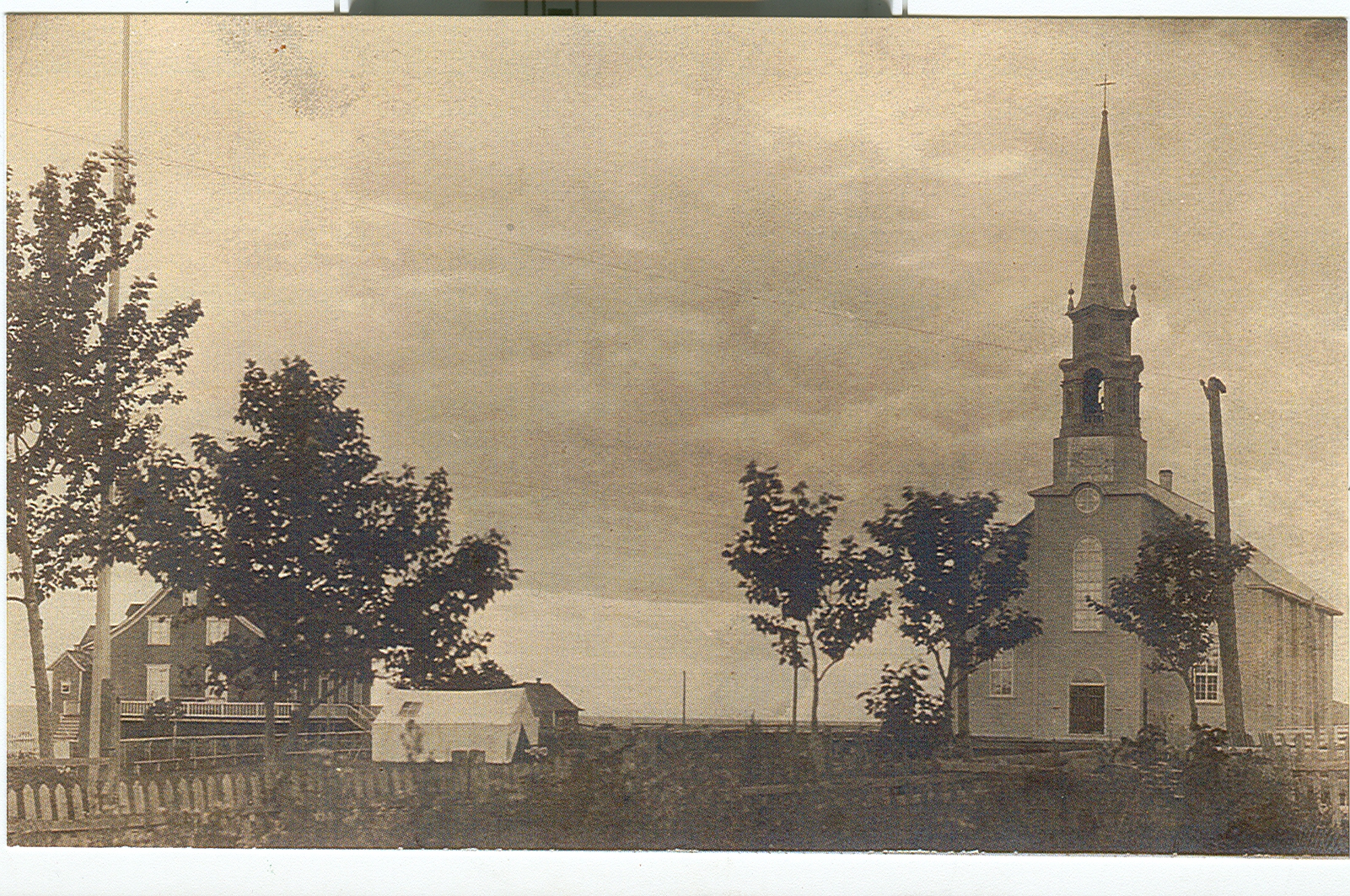
The first church was built in 1881.
Officially established on January 1, 1866, the municipality of Sainte-Félicité had François Turcotte as its first mayor. On January 15, 1866, the members of the municipal council were appointed, but it was not until June 25, 1870, that the civil erection of the parish of Sainte-Félicité was officially recognized by the Cabinet.
In 1880, the territory attached to Sainte-Félicité was very large, including part of the seigneury of Matane and portions of the townships of Saint-Denis and Cherbourg. In 1933, Sainte-Félicité lost part of its territory when Saint-Adelme separated. Grosses-Roches did the same in 1939. A similar scenario occurred in 1945 with a portion of Saint-Victor de Petit-Matane and again in 1947 with Saint-Jean-de-Cherbourg.
Départs nombreux vers les États et dépression de 1929
“The global economy experienced major economic crises between 1873 and 1878, and again between 1891 and 1896. During these periods, the exodus of families from the region to the United States began and later expanded significantly, a movement greatly facilitated by the arrival of the railway in the area in 1875. Many families went to the United States to seek their fortune following the depression. Work in spinning mills and wooden box factories was in high demand and accessible to everyone—women, children, and fathers alike. Fortunately, many families returned after a few years of work with an improved financial situation.
“The economic crisis of 1929 put the paper mill project in Baie-Comeau on hold. In 1936, Charles Normand, an entrepreneur from the parish, went to Baie-Comeau to clear the site for the Québec North Shore Paper Company mill. Afterwards, he began logging along the Lac à la Loutre Road (Rivière-aux-Outardes). He employed many local fathers as well as their sons, who would leave the region to work on the logging sites during the winter.
Church fire and reconstruction
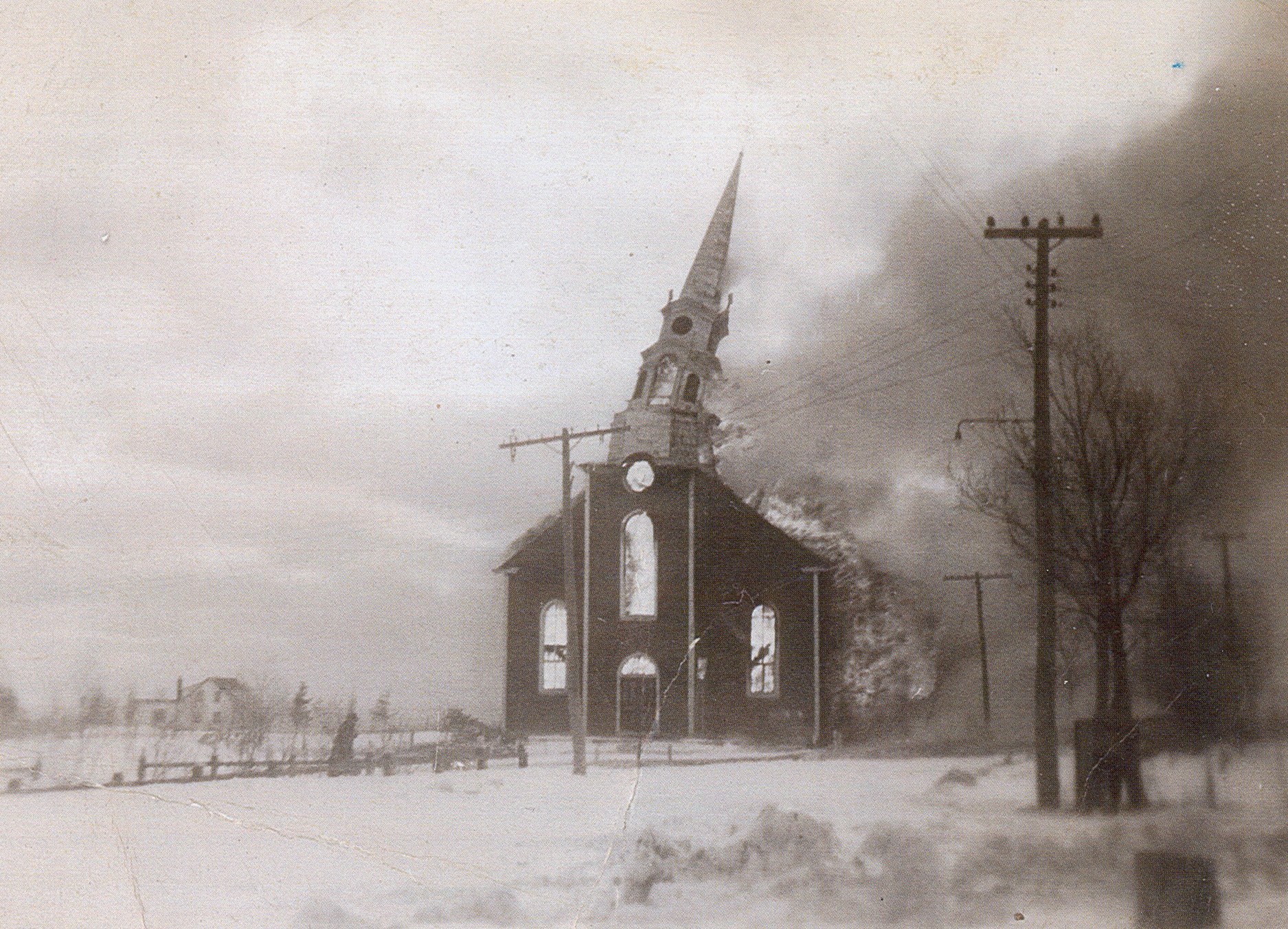
Church fire on April 28, 1947.
On April 28, 1947, the church was engulfed in flames. The ornaments and sacred vessels were saved. The fire is believed to have been caused by the central heating system.
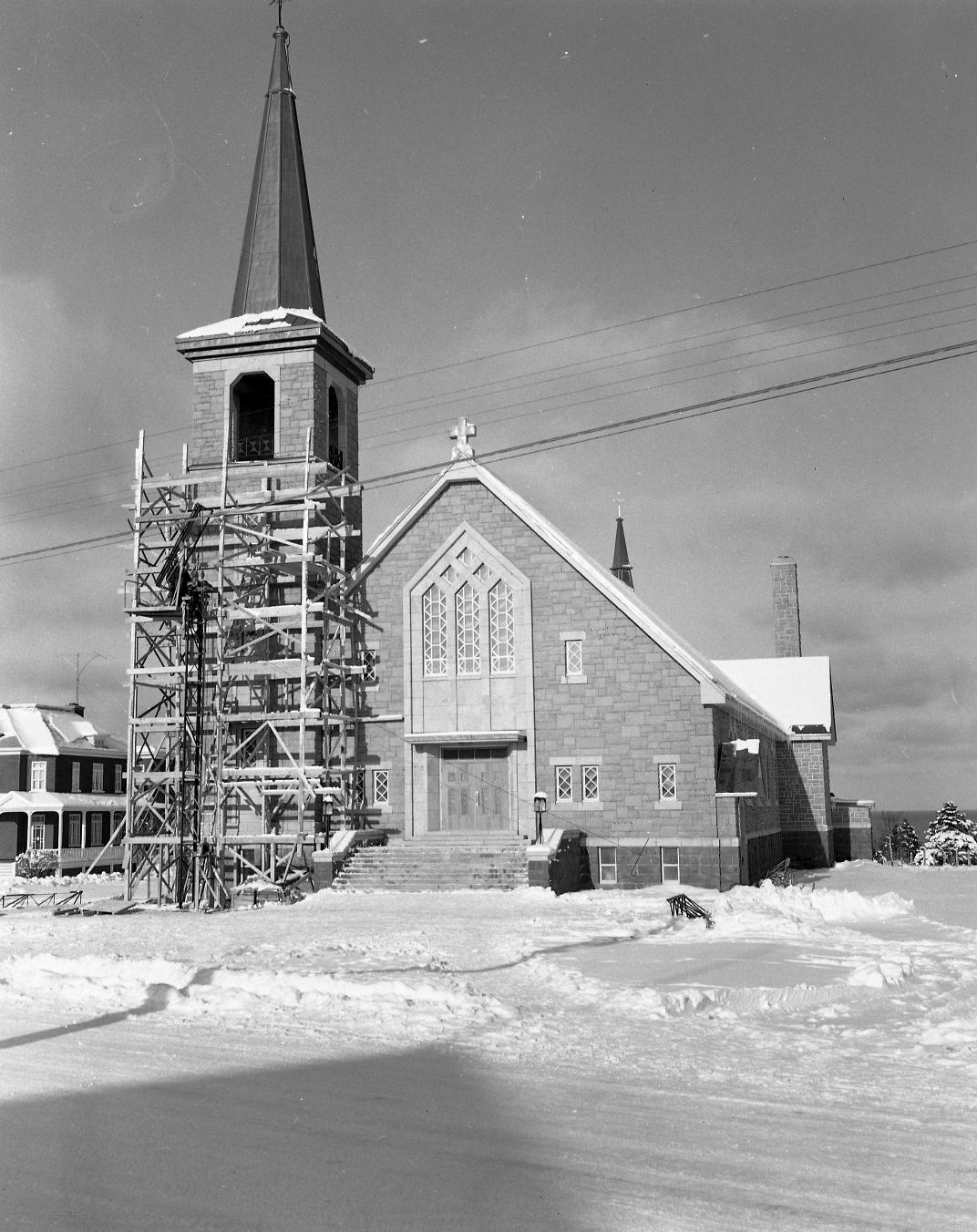
Construction of the new stone church
Construction of the new church’s basement began in 1948. This basement served as a temporary sanctuary until 1957. The church was ready for the midnight Mass of 1957.
Schools
Construction of the new stone church
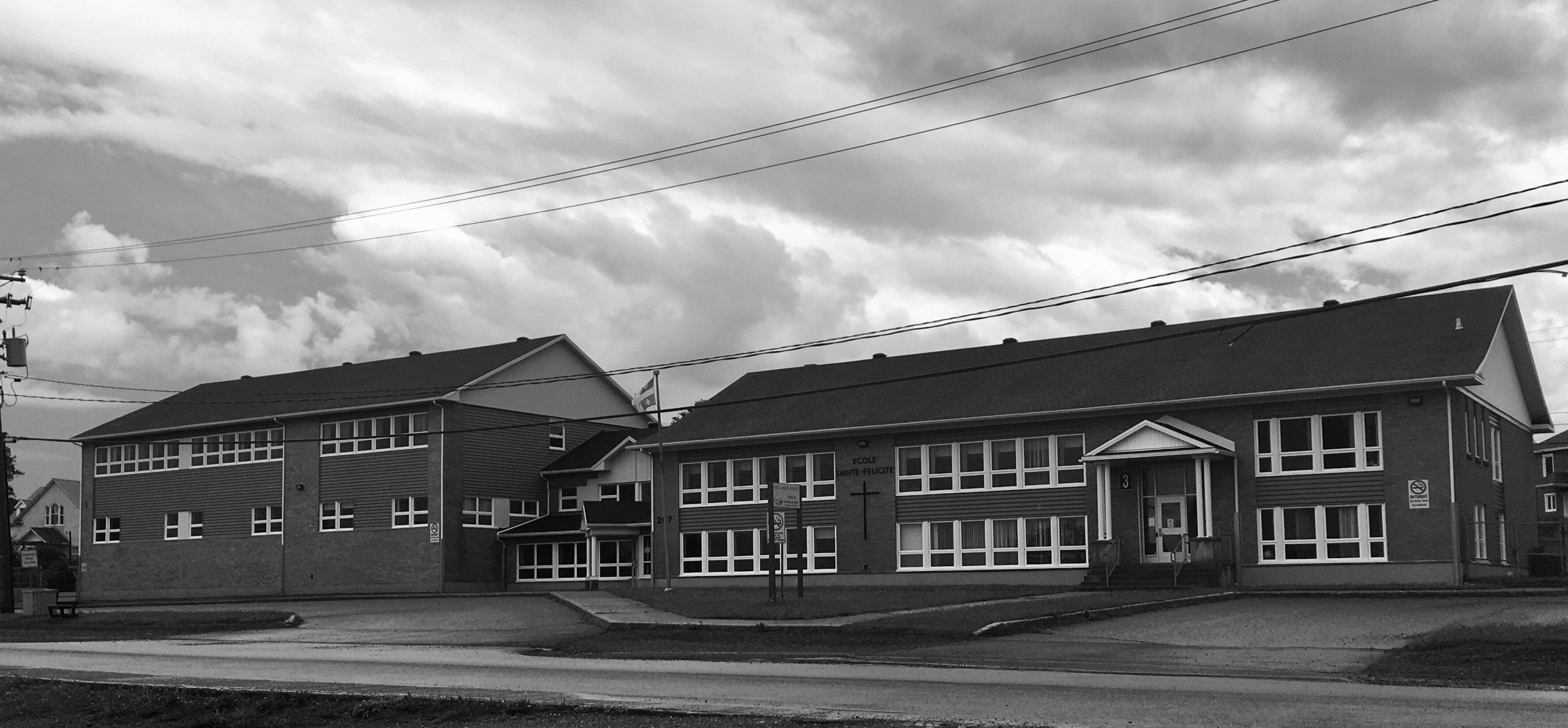
It is difficult to find information that would allow us to accurately record the start dates of schools in Sainte-Félicité. In Quebec, the foundations of the school system were laid in 1855. Later, the government transferred responsibility for the school system to the Catholic Church. In 1864, it appears that a salary was paid to a female teacher. Often, young girls were hired to teach at a salary of $66 to $72 per year. By 1874, the territory had four schools. In 1885, the model school was opened. Aiming to centralize education in the village, the convent was built in 1946, Saint-Joseph School (Sirois) in 1951, and Gagnon School in 1956.
During the 1970s, local school boards underwent major changes following the adoption of Bill 27 by the Quebec government, which aimed to reform them. The Catholic hierarchy lost some of its authority over education, and education became a state responsibility. In 1972, the Sainte-Félicité School Board was merged with the Matane School Board for primary education, while secondary education came under the Regional School Board of the Monts. Then, in 1983, the two school boards were merged into a single entity, the Matane School Board.
Schools
Construction of the new stone church
The mergers marked the beginning of the decline of village schools. Some villages would lose their schools. Sainte-Félicité managed to keep its schools, but their facilities were outdated and in need of repairs and restructuring. In 1989, renovations were undertaken at a cost of $1.2 million. The Saint-Rosaire Convent (home to the Sisters of Saint-Rosaire) was sold and moved to the other side of Boulevard Perron. There, housing was arranged for the sisters, the village municipal office, and rooms for the Cercle de Fermières. Sirois School, nicknamed the middle school, was relocated (its foundation was used for the construction of the gymnasium) and is now connected to Gagnon School, where administrative services are centralized.”
The demographic decline of the villages brought further changes. Another school board merger took place: Matane’s board merged with that of Matapédia, becoming in 1998 the Monts-et-Marées School Board. Finally, in the 2000s, Sainte-Félicité lost its secondary education. Ultimately, after half a century of mergers, school boards themselves were abolished under a new educational reform—one that we hope is for the better today.
Hobbies
In 1940, the Sainte-Félicité Sports Association was founded, which later became the Œuvre des Terrains de Jeux (OTJ). In 1972, the skating rink, previously located near the rectory, was relocated to a field across from Veilleux Street. A tennis court, a softball field, and a building were added, which was expanded over time. After the dissolution of the OTJ, the village and parish municipalities partnered to construct a new building. The building was moved in the summer of 1994 and housed game rooms, an arcade, a kitchen, and a hall named Alphonse-Simard, a councilor who had passed away shortly before the project was completed. A few years later, a library and the Félicinet Internet Access Center were added. The sports center, which became the community center, hosts numerous activities, including pétanque, various classes, and sporting events.
Over time, activities became increasingly well organized, yielding impressive results. Notable achievements include those of Marie-Andrée Lévesque in table tennis, including a bronze medal in the women’s doubles at the North American Championship, and Roger Caron in rifle shooting, who participated in the Sydney Olympic Games.
Demolition of the wharf

Sainte-Félicité Wharf
“The municipal council submitted numerous requests to the federal government to repair its wharf. According to the mayor at the time, Raymond Desjardins, the wharf was an undeniable tourist attraction, a safe haven for fishermen, and a protective barrier against strong waves. Since the government’s goal was to eliminate small ports in favor of larger ones, it gave only one response: the demolition of the wharf. This was carried out in 1970 without reinforcing the riverbank, putting some houses at risk and threatening part of the road network. After the demolition, a wall was finally built.
An unforgettable tragedy
Several tragic events have occurred in Sainte-Félicité. One need only think of accidents at La Courbe du Criard and Cap-à-la-Baleine, or drownings. But one tragedy is unforgettable, even though it happened on the Côte-Nord: the drowning of 12 lumberjacks, six of whom were from Sainte-Félicité. Many of them were married with children. These workers were employed by the subcontractor Damien Fortin from Matane and were clearing land for an Hydro-Québec power line north of Godbout. A camp had been established, and they were returning from it to spend a few days with their families. The tragedy occurred upon arriving at Lac Achigan. An aluminum rowboat awaited them. It had a capacity of about four to five people with their luggage. For reasons unknown, all 12 decided to board. Shortly after leaving, the boat capsized about 150 feet from shore. They didn’t even have time to start the engine. Although several of them were good swimmers, no one managed to reach the shore. The bodies were recovered, and on Wednesday, November 4, 1970, the funerals of Michel Bergeron, Gaétan Couture, and the four Deroy brothers—Eddy, Gilles, Mario, and Wilbrod—were held.
The Village Municipality
December 18, 1954, marks the creation of the Municipality of the Village of Sainte-Félicité. From that point on, there were two municipalities—the village and the parish—and two administrations, necessitating the reorganization of drinking water supply and fire services. In 1960, a dam was constructed to store water. The installation of a drinking water distribution network also allowed for the management of wastewater. Later, wastewater treatment infrastructure was built. In 1991, the village municipality began constructing buildings that would house the municipal office and the fire department.
In 1995, the village and parish municipalities began steps to merge, which was completed in January 1996. Later, another merger was considered during the wave of municipal amalgamations in Quebec, but the merger of Sainte-Félicité with the City of Matane did not take place.
Over the past several decades, the municipality of Sainte-Félicité has experienced a population decline of about 600 people. The population decreased from 1,612 in 1971 to 1,065 in 2016.
A hot air balloon at Rosaire’s
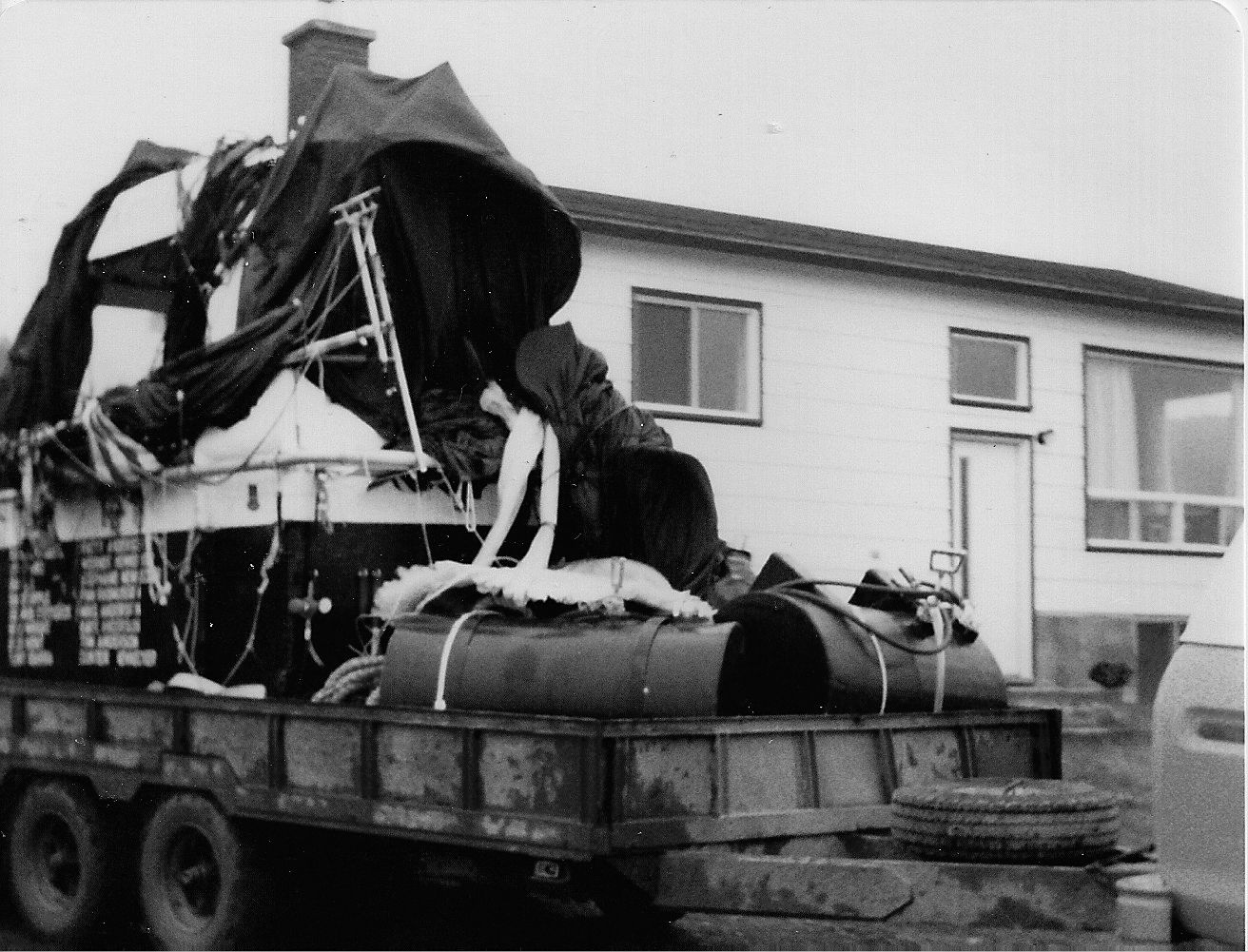
Kitty Hawk, the hot air balloon of the Americans Maxie Anderson and his son Chris, on Rosaire Plourde’s property.
It is difficult to find information that would allow us to accurately record the start dates of schools in Sainte-Félicité. In Quebec, the foundations of the school system were laid in 1855. Later, the government transferred responsibility for the school system to the Catholic Church. In 1864, it appears that a salary was paid to a female teacher. Often, young girls were hired to teach at a salary of $66 to $72 per year. By 1874, the territory had four schools. In 1885, the model school was opened. Aiming to centralize education in the village, the convent was built in 1946, Saint-Joseph School (Sirois) in 1951, and Gagnon School in 1956.
During the 1970s, local school boards underwent major changes following the adoption of Bill 27 by the Quebec government, which aimed to reform them. The Catholic hierarchy lost much of its authority over education, and education became a state responsibility. In 1972, the Sainte-Félicité School Board was merged with the Matane School Board for primary education, while secondary education came under the Regional School Board of the Monts. Then, in 1983, the two school boards were merged into a single entity, the Matane School Board.
Bombardier Series
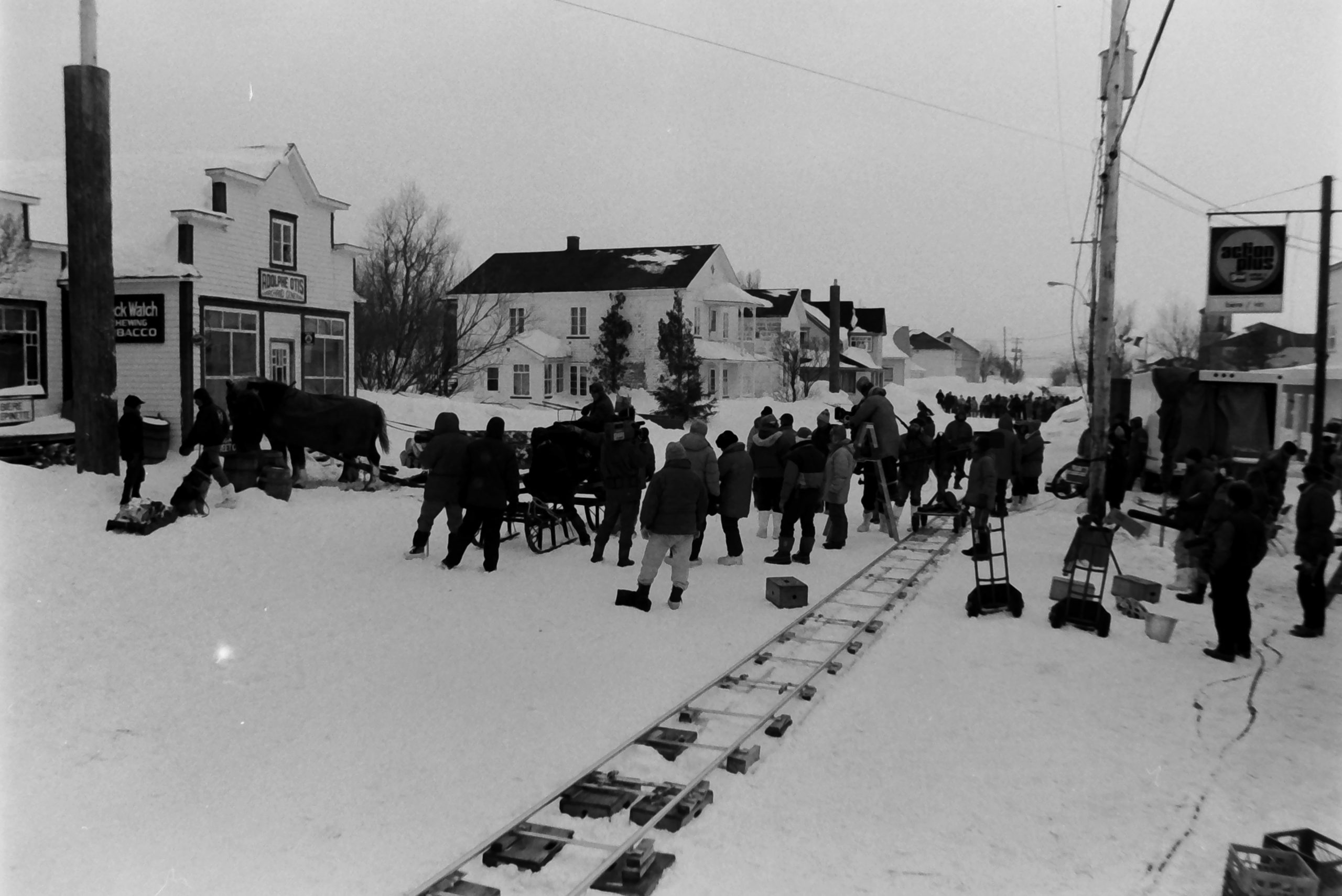
The Bombardier Series
In March 1991, Adolphe Otis’s general store experienced a second life during the filming of the Bombardier Series. After renovations to add a billiard room and conceal wires and utility poles, the series scenes began, depicting Joseph-Armand Bombardier as a teenager. Of course, there was plenty of snow.
R. Desjardins Sawmill (2000)
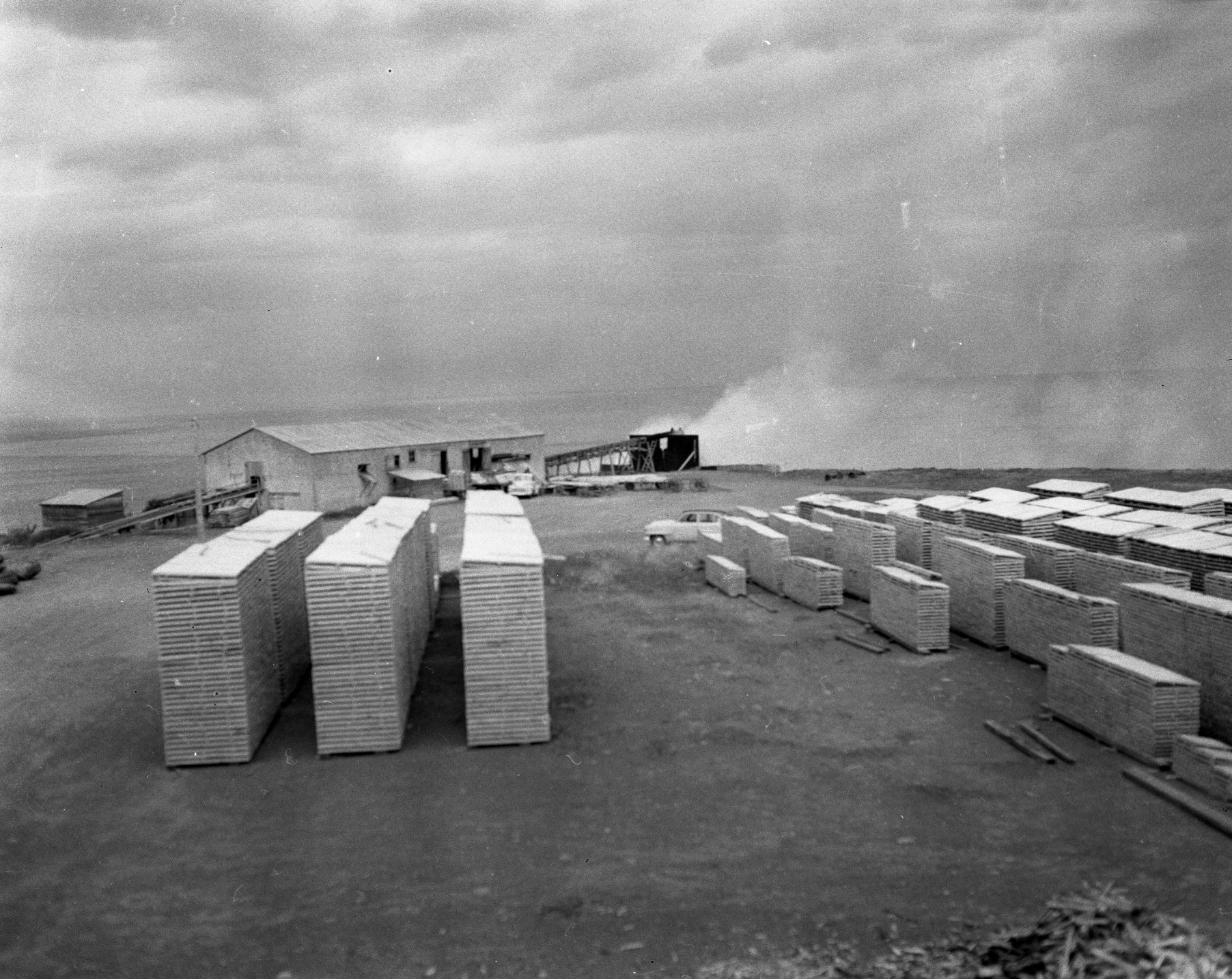
Raymond Desjardins Sawmill acquired from Joseph-Arthur Saint-Pierre
“The R. Desjardins Sawmill, the oldest industry in the municipality, partnered in 1999 with the Monts Resource Development Company (Société d’exploitation des ressources, SER). It became a victim of the 27.2% compensatory duties imposed by the United States. The mill closed in mid-June 2003 and was subsequently sold to the SER of the Valley (Multi-Bois), but it was never reopened. It had been an important employer in Sainte-Félicité, both in the factory and in the logging sites.
Culture
The fields of literature, theater, and music shine in Sainte-Félicité. Sergine Desjardins, a writer, novelist, and essayist born at Cap-à-la-Baleine, has written numerous articles for various newspapers and magazines, as well as historical novels that have earned awards. Viateur Lefrançois, a native of Sainte-Félicité, is a children’s literature author highly appreciated by thousands of readers. There is also Véronique Gagné, who brought the famous clown Atchoum to life. A youth rock singer, her popularity continues to grow.
Finally, the singer Isabelle Boulay brings fame to Sainte-Félicité. Since winning the Performer and Audience Awards at Petite-Vallée in 1990, she has received numerous recognitions. As an international artist, she shines a spotlight on the Matane region. Sainte-Félicité paid tribute to her by naming a park in her honor.
Sainte-Félicité
Anciennement Pointe au Massacre
Le fleuve Saint-Laurent, en tant que voie navigable majeure, a joué un rôle important dans l’histoire de cette paroisse. Le nom de Sainte-Félicité — anciennement connu sous le nom de Pointe-au-Massacre — évoque les naufrages qui se sont produits sur ce promontoire s’avançant dans la mer, ainsi que l’installation de ses habitants. En effet, le fleuve Saint-Laurent a été, et continue d’être, au cœur du développement de la région.
Un petit retour en arrière s’impose. En 1867, la Confédération canadienne a confirmé la compétence du Québec sur le territoire du Bas-Canada, lui permettant ainsi de prendre en charge l’éducation, la culture et le droit civil français. Sur les plans économique et social, le secteur agricole avait besoin d’un nouveau souffle. De 1760 à 1870, la population du Québec a doublé tous les 25 ans. Cette croissance a nécessité une nouvelle expansion du territoire.
Un petit retour en arrière s’impose. En 1867, la Confédération canadienne a confirmé la compétence du Québec sur le territoire du Bas-Canada, lui permettant ainsi de prendre en charge l’éducation, la culture et le droit civil français. Sur les plans économique et social, le secteur agricole avait besoin d’un nouveau souffle. De 1760 à 1870, la population du Québec a doublé tous les 25 ans. Cette croissance a nécessité une nouvelle expansion du territoire.